


To answer that question we must first understand the importance of play. If we understand, on the most basic level, that play is essential to leading a happy and healthy life, then one would have to answer, "Yes. We should all make time for play, not just children but adults as well."
An overwhelming body of research on the issue of the importance of play has continued to grow especially recently. From babbling as a baby in the practice of early language development to coed adult slow pitch softball leagues, play is practice for life's many challenges
grandfather and kid playing
Take for example, "follow the leader". Children learn to lead, follow, cooperate, imitate, plan and negotiate their own conflicts. Or as in the case of adult softball, play is a laboratory for practicing work related skills of teamwork, loyalty, and dedication.
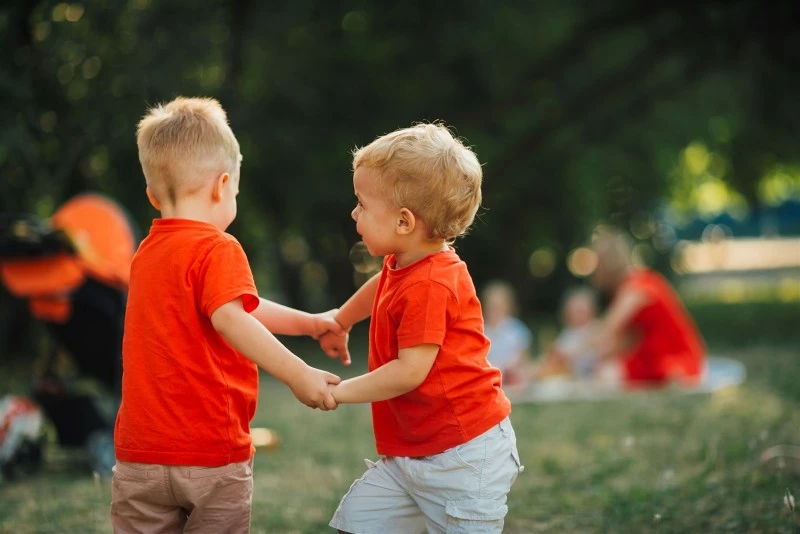
Play is the spontaneous activity in which children engage to amuse and to occupy themselves. It is also a way children optimize their own brain development. Viewed from this perspective, the nostalgic observation that children "no longer play" should be taken seriously because the consequences for children's well-being extend beyond the problem of childhood obesity.
Play and development
A 2007 report from the American Academy of Pediatrics documents that play promotes not only behavioral development but brain growth as well. The University of North Carolina's Abecedarian Early Child Intervention program found that children who received an enriched, play-oriented parenting and early childhood programs had significantly higher IQ's at age five than did a comparable group of children who were not in the program (105 vs. 85 points).
American Academy of Pediatrics – The Importance of Play
"With play on the decline, we risk losing these and many other benefits. For too long, we have treated play as a luxury that kids, as well as adults, could do without. But the time has come for us to recognize why play is worth defending: It is essential to leading a happy and healthy life," according to play expert and author, David Elkind. He encourages us by saying, "When we adults unite play, love, and work in our lives, we set an example that our children can follow. That just might be the best way to bring play back into the lives of our children-and build a more playful culture."
Play and its close relationship with recess
Recess contributes to academic success.
The 2009 February issue of the Journal Pediatrics, shows that students who received more than 15 minutes of free play a day were better behaved than those who had no recess period. The researchers argue that these findings, along with similar findings from other studies, "support the
importance of recess for student attentiveness in the classroom."
The relationship between academics and play appears to be in constant tension, as though adding to one results in taking away from the other. Nothing could be further from the truth. It would appear that recess contributes to academic success in a variety of ways.
Play and academics
Contrary to popular opinion, education is not a race. It is faulty reasoning to believe that the sooner children enter into an academic setting the sooner they learn to read, calculate and acquire academic skills, thus gaining a step-up on pint size adversaries. Child development experts and child psychologist agree that children develop readiness for learning most skills through play.
China Customized Kids Puzzle Mat Manufacturers Suppliers Factory - Wholesale Service (faithmat.com)
Alliance for Childhood – Crisis in Kindergarten: Why Children Need to Play
Rushing children through instruction that they are not ready for can result in a frustrated child who begins to question their learning abilities and internalize their perceived failings by feeling "less than" the child sitting next to them. The old adage, "success breeds success and failure breeds failure" should not be ignored. Yet, since the No Child Left Behind Act was implemented in 2002, there has been a general focus on academics much to the dismay of the play community.
Early childhood programs shifted their emphasis from play, to a more academic curriculum. The result, according to several studies by Kathy Hirsch-Pasek and colleagues, indicates that there has not been an academic advantage in either reading or math for children in these programs. In fact, children dropped into academic settings too soon, show increased test anxiety, were less creative, and displayed more negative attitudes toward school than other children in play oriented preschool environments. Further, by pushing them into certain activities before they are ready, we run the risk of stunting the development of important intellectual, social, or emotional skills in our children.
Consider the metaphor of the flower. While it is true we can engineer its early bloom through artificial light, and Miracle Grow type nutrients, the lifespan of the engineered bloom is significantly decreased and undeniably more fragile when compared to a flower grown in the natural environment and allowed the luxury of time. Children too should be afforded this opportunity to unfold naturally without artificial engineering.
It is important to acknowledge that play is not meant to be educational. Rather education flows naturally into the environment of a child at play.


