


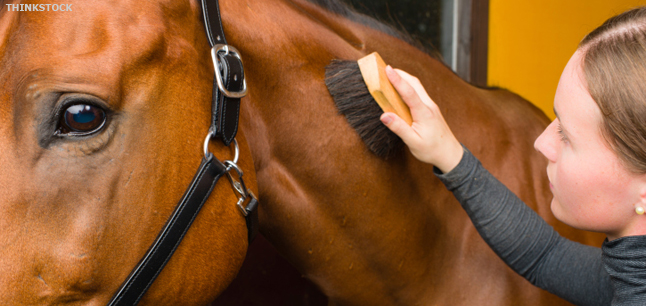
Stablehands or grooms work in stables and look after horses, keeping them clean, comfortable, fed, exercised and groomed. They may take special care of foals.
The Work
You could be:
feeding and watering horses
keeping horses clean and grooming them – brushing their coats and oiling their hooves
mucking out (cleaning) stables and putting down new bedding
cleaning saddles, bridles and other riding gear ('tack') and fitting them on horses
riding horses to exercise them
clipping horses' manes or tails, using clippers and scissors
checking horses for injuries or illness and following care instructions from vets
getting horses ready for riding lessons or for sports like eventing or horseracing
specialising in a certain area, such as racing, breeding, showjumping or trekking
Pay
The figures below are only a guide. Actual pay rates may vary, depending on:
where you work
the size of company or organisation you work for
the demand for the job.
Starting pay is often based on the National Minimum Wage (NMW) or the National Living Wage (NLW).
As of 1 April 2024 the National Minimum Wage is £6.40 an hour for workers under 18, £8.60 an hour for workers aged 18 to 20. The National Living Wage for those aged 21 and over is £11.44 an hour.
An experienced or head groom might expect to earn between £16,000 and £20,000 a year.
You may get free accommodation and food, a stable for your own horse and perhaps riding lessons.
Conditions
You could work in a riding school, a trekking centre, a livery stable which keeps other people's horses, or a stable where horses are bred.
The working conditions can be dirty, muddy and smelly, especially when mucking out stables.
A lot of your work would be outdoors, sometimes in bad weather.
There is a risk of injury if a horse bites or kicks you or if you fall off.
Working hours are long, including early starts, late finishes and weekends.
Stables may be a long way from towns, sometimes in quite remote areas.
You might have to live at the stables, perhaps sharing with other stable workers.
You would sometimes wear protective clothing, such as riding boots, a hard riding hat and body protector.
Workforce Employment Status
Full time: 54.2%Part time: 23.5%Self Emp.: 22.3%
| Emp Type | Employed |
|---|---|
| Full time: 54.2% | 43,210 |
| Part time: 23.5% | 18,700 |
| Self Emp.: 22.3% | 17,784 |
LMI data powered by LMI for All
Getting In
A good general education is useful. Some employers may prefer you to have a few subjects at National 4 or 5 including English.
A real interest in and enthusiasm for horses is just as important as formal qualifications.
You could do a relevant college course before starting work. There are courses in horse care or equine studies at NC (SCQF Levels 4-6), HNC (SCQF Level 7) and HND (SCQF Level 8).
You might get in through a Modern Apprenticeship in Equine at SCQF Level 5.
You might complete the British Horse Society (BHS) Stages 1 - 3 of the Groom Pathway. See BHS website for details.
You normally need up to 4 subjects at National 4 or 5 for entry to the NC and 1-2 Highers, or relevant NC or experience for the HNC or HND.
You usually need previous work experience with horses, including voluntary work, and not have an allergy to horses.
You might need a full, clean driving licence.
You must be fit enough to carry out physical work.
Workforce Education Levels (UK)
| Level | Percentage |
|---|---|
| Postgraduate | 3 |
| Degree | 21 |
| HNC/HND | 11 |
| Higher/SVQ | 30 |
| National 5/SVQ | 26 |
| National 4/SVQ | 4 |
| Entry Level | 5 |
LMI data powered by Lightcast
Job Outlook Scotland
Employment
2022202420262028203020325,4005,6005,8006,000Jobs
| Year | Employed |
|---|---|
| 2,021 | 5,550 |
| 2,022 | 5,485 |
| 2,023 | 5,505 |
| 2,024 | 5,585 |
| 2,025 | 5,653 |
| 2,026 | 5,704 |
| 2,027 | 5,746 |
| 2,028 | 5,772 |
| 2,029 | 5,790 |
| 2,030 | 5,803 |
| 2,031 | 5,812 |
| 2,032 | 5,818 |
LMI data powered by Lightcast
Job Outlook Scotland and UK

LMI data powered by Lightcast
What Does it Take?
You must be:
self-motivated
dedicated
passionate about working with horses
able to ride safely and well
observant – to spot injuries or illness
physically fit with good stamina
safety conscious and able to follow instructions
able to work alone and also as part of a team.
Training
You would train and gain experience on the job with your employer.
You may study part time for a qualification such as a Scottish Vocational Qualification (SVQ) or an HNC.
Getting On
With experience you may be promoted to head stablehand or groom.
You could take the BHS Stage 4 and 5 qualifications to become a stable manager.
If you take more qualifications you might be able to become a riding instructor.
In time, you might be able to run your own stable, although it can be very costly to set up stables.


