



By ALICE COLLINS/JUMP MEDIA
Looking after horses and keeping them safe, happy, and healthy in extreme heat presents a unique set of challenges. With summer temperatures reaching record highs in recent years, there are crucial signs that owners need to watch out for and key steps to take when caring for horses in sweltering conditions.
How do you know if a horse is in distress, and what can you do to help them cool down? Horses are all individuals, but there are some common warning signals to monitor on hot days, and there are ways to keep performance horses fit while the weather is hot.
"In the first instance, see if the horse has shallow, labored breathing, whether their breathing is catching, or they are panting like a dog," counsels Dr. Scott Swerdlin, a Florida native and President of Palm Beach Equine Clinic (PBEC) in Wellington, FL.
"Check if they are breathing from the mouth, because if they are mouth breathing, you're in trouble.
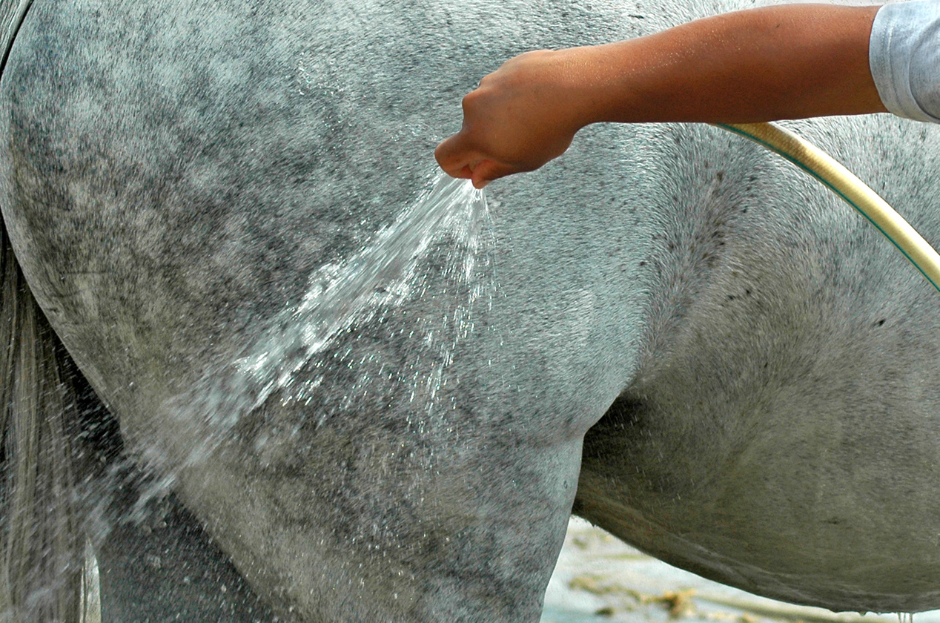
"Stop what you're doing and immediately cool the horse down. Take the tack and any boots or bandages off - horses can retain a lot of heat in their distal extremities - and hose them down, including rinsing out the mouth, the legs, and under the tail. The neck and body are the most important thing to rinse and keep hosing until they cool off."
Have the Right Equipment on Hand
Dr. Swerdlin advises that any barn at risk of a high-heat event should always keep a stethoscope and a thermometer on the property. Digital thermometers are easy to use, cheap, and available at every drug store. Ensure they are in good working order; a thermometer that has been left in the blazing sun may not give an accurate reading.
"After you've run the hose on the horse with cold water, take their temperature to check it has dropped," he says. "Watch to see if the horse's breathing is still rapid and shallow. Normal breathing is 12 to 16 breaths per minute, but a really over-heated horse can go as high as 60 breaths a minute."
Ice boot wraps kept in the freezer are another important tool that can aid in bringing a horse's body temperature down more quickly.
"The wraps can really help a lot," adds Swerdin. "Not only can you use them on the legs, but you can also wrap them around the neck area to help lower the temperature as fast as possible. I would recommend to contact your veterinarian if the horse's vital signs remain abnormal beyond 30 minutes."
Keeping Cool
It's notoriously hard to keep horses cool in stalls when the humidity is high and there may not be great natural air circulation.
"Misting fans work great, and these days you can get some really large ones," says Swerdlin. "They can lower the temperature in a stall by 10 to 12 degrees. And you only need 10 degrees of lowering to prevent anhidrosis, which occurs when the horse stops sweating, meaning they become incapable of temperature regulation.
"Anhidrosis occurs when horses sweat after they work, then sweat all night when not working. When their body doesn't get a rest from the sweating, the body quits, and they stop sweating. You then have to go through a whole regime to teach a horse to sweat again," continues Swerdlin. "There are lots of things that vets can do for non-sweaters, but most respond well when put in a stall with a misting fan, and they usually start sweating again after a couple of weeks."

Deciding When - and Whether - To Exercise
Competition horses often have busy schedules, but during the hottest months it is critical to assess the horse's ability to work before rigidly adhering to any pre-planned schedule.
"Use the stethoscope to check the horse's resting heart rate," advises Swerdlin. "If you see a heart rate over 60 when the horse is not exercising, then the horse is having some problems and shouldn't be worked."
The question of when to exercise is tremendously important, as is where that exercise takes place.
"Ride at dawn or dusk to help prevent overheating," says Swerdlin. "If you have the option of using an indoor or covered arena and staying out of the sun, that is much better than outside arenas. Rings with fans are also a lot cooler."
If the temperature is over 104 degrees Fahrenheit, Swerdlin recommends that horses not be worked at all. Also consider the heat index, which is the temperature plus humidity. Use caution when the heat index is greater than 150 and watch for signs of heat stress. It is recommended to use extreme caution when the heat index is greater than 180 because normal cooling is almost ineffectual. In extreme cases, it may be necessary to remove the horse from the high temperature environment altogether, to another state or more suitable facility.
Give Water and Electrolytes
Anyone caring for horses in high temperatures should ensure they always have access to fresh water, and buckets should be checked three times a day.
"We recommend giving horses electrolytes," says Swerdlin. "Some like them and some don't, and we prefer to offer it in water rather than feed as it can often get left at the bottom of the feed bucket.
"We advise giving two buckets of water, one with electrolytes in it and the other of clean, fresh water. There are some horses who will not drink the electrolyte water, so they must also have a clean water bucket; otherwise, they may not drink at all," he adds.
Manging the Environment
The key to keeping horses comfortable in extreme heat is good, careful management of their routine and surroundings.
"Start looking for opportunities to change the horse's environment and your own habits, like the time when you ride," says Swerdlin. "Sometimes a simple fan can't lower the temperature enough, so consider a misting fan. They can be expensive, but they do the job, and they're not that expensive when the alternative is having a non-sweating horse that you can't train and who needs medication.
"Don't turn out in the middle of the day for more than two hours – let the horse have a little leg stretch and then bring them in. Always try to use a paddock that has some shade, if possible," he concludes.
Horses that grow a thick coat should be kept clipped during the warmer months of the year.
The good news, advises Swerdlin, is that horse management in high temperatures is not normally a veterinary issue, but more a question of adjusting management and scheduling a routine suitable for the conditions.


